
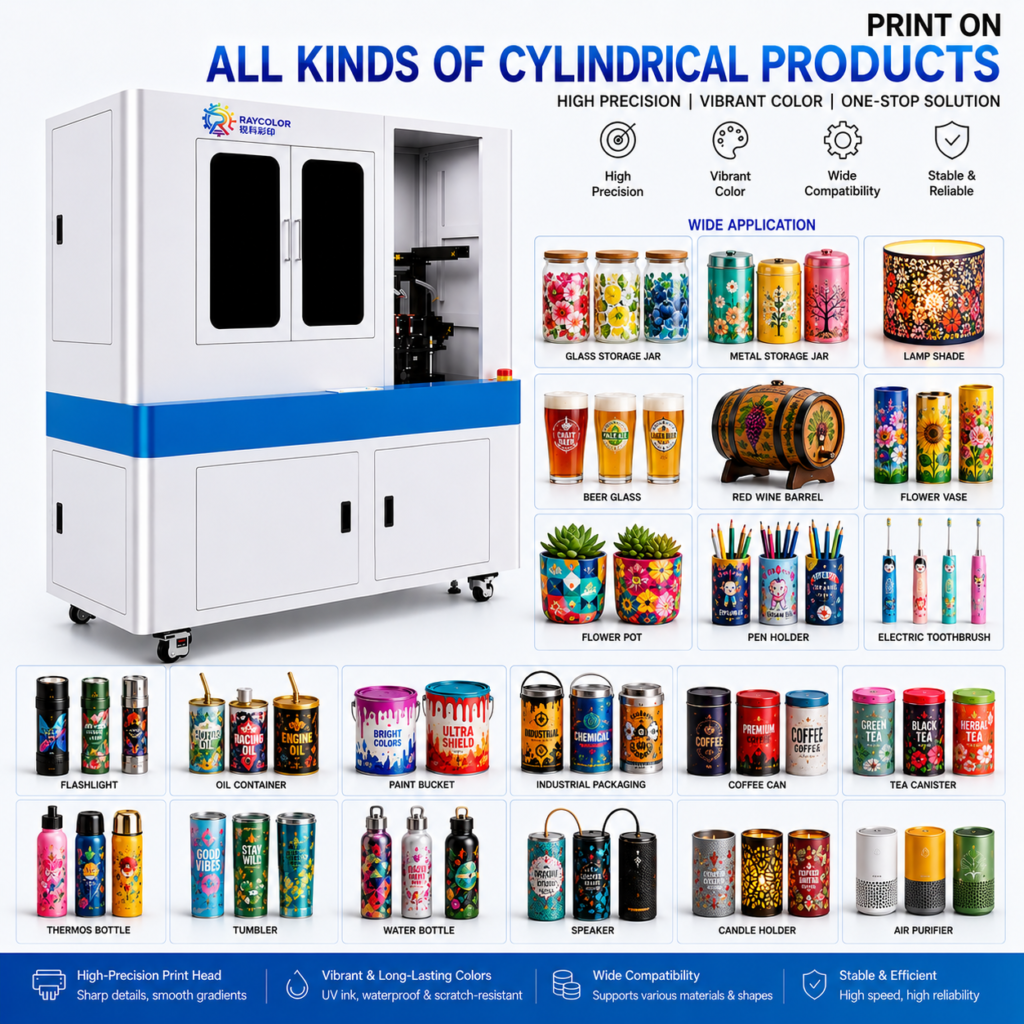
direct-to-object and direct-to-shape printing helps brands and manufacturers create durable, high-resolution decoration with flexible direct UV technology.
Introduction
The customization industry is undergoing a major transformation.
Traditional decoration methods such as labels, screen printing, heat transfer, pad printing, and shrink sleeves are increasingly being replaced by more advanced digital technologies.
Among the most exciting innovations are:
Direct-to-Object (DTO) Printing
Direct-to-Shape (DTS) Printing
These technologies allow manufacturers to print directly onto finished products without using labels, stickers, or transfer processes.
From stainless steel tumblers and cosmetic bottles to candle jars, aluminum cans, wine bottles, and industrial containers, direct printing is becoming the preferred solution for brands seeking higher quality, greater flexibility, and faster production.
In this article, we will explore what Direct-to-Object and Direct-to-Shape printing are, how they work, and why they are transforming modern manufacturing.
What Is Direct-to-Object Printing?
Direct-to-Object (DTO) printing refers to printing graphics, logos, text, and images directly onto a physical product.
Instead of printing on paper, labels, or film, the printer deposits ink directly onto the final object surface.
The process eliminates:
Labels
Stickers
Transfer films
Secondary decoration steps
The printed design becomes part of the product itself.
Common applications include:
Tumblers
Water bottles
Cosmetic packaging
Candle jars
Glass bottles
Aluminum cans
Promotional products
Industrial containers
Modern UV inkjet technology has made Direct-to-Object printing one of the fastest-growing digital printing segments worldwide.
What Is Direct-to-Shape Printing?
Direct-to-Shape (DTS) printing is an advanced form of Direct-to-Object printing.
While DTO refers broadly to printing directly on objects, DTS specifically focuses on printing directly onto three-dimensional shapes and curved surfaces.
Examples include:
Cylinders
Cones
Tapered bottles
Wine bottles
Cosmetic containers
Sports bottles
Candle holders
Irregular packaging
Unlike flatbed printing, Direct-to-Shape technology follows the contour of the object to ensure accurate image placement across curved surfaces.
This capability enables true 360° decoration without labels or seams.
How Direct-to-Shape Printing Works
Modern Direct-to-Shape UV printers combine several technologies:
Product Scanning
The printer measures:
Diameter
Length
Shape profile
Surface position
Shape Modeling
Software creates a digital model of the object.
Automatic Positioning
The machine automatically adjusts:
Printhead height
Printing angle
Product rotation speed
UV Printing
UV-curable inks are deposited directly onto the object.
Instant UV Curing
UV lamps instantly cure the ink, creating durable, vibrant graphics.
The entire process can be completed in a single workflow.
Why Traditional Decoration Methods Are Losing Ground
For decades, manufacturers relied on:
Labels
Problems include:
Peeling
Bubbling
Wrinkling
Additional inventory
Screen Printing
Problems include:
High setup costs
Limited color capability
Difficult customization
Pad Printing
Problems include:
Small print areas
Limited image quality
Heat Transfer
Problems include:
Multi-step production
Additional labor
Potential durability issues
As brands demand shorter production runs and more personalization, these methods become less efficient.
Digital Direct-to-Object printing eliminates many of these limitations.
Key Advantages of Direct-to-Object Printing
1. No Labels Required
The design is printed directly onto the product.
Benefits include:
Cleaner appearance
Premium branding
Lower material costs
Many luxury brands now prefer direct printing because it creates a more professional look than labels.
2. Unlimited Color Capability
Traditional decoration often requires separate setup for each color.
Digital UV printing supports:
Full-color graphics
Gradients
Photographic images
Variable data printing
without additional setup costs.
3. Fast Product Changeovers
Modern manufacturers often produce:
Small batches
Seasonal designs
Personalized products
Direct-to-Object printing allows instant design changes without replacing screens or tooling.
4. Reduced Inventory
Brands no longer need to stock:
Pre-printed labels
Packaging variations
Multiple SKU versions
Products can be decorated on demand.
5. Better Sustainability
Direct printing reduces waste by eliminating:
Label backing paper
Transfer materials
Excess packaging components
This helps companies meet sustainability goals.
Why Direct-to-Shape Printing Is Ideal for Cylindrical Products
Many consumer products are not flat.
Examples include:
Tumblers
Water bottles
Wine bottles
Cosmetic bottles
Candle jars
Aluminum cans
Storage jars
Traditional printers struggle to maintain image quality on curved surfaces.
Direct-to-Shape technology solves this problem through synchronized rotation and precision ink placement.
The result is:
Seamless wraparound graphics
Better image alignment
Higher production consistency
The Importance of Automatic Taper Compensation
Not all cylindrical products are truly cylindrical.
Many products are tapered, including:
Travel mugs
Stainless steel tumblers
Cosmetic containers
Sports bottles
Without compensation, images may become distorted.
Modern industrial Direct-to-Shape systems use Automatic Taper Compensation (ATC) to automatically adjust the printing path according to the object’s geometry.
This ensures accurate image reproduction from top to bottom.
Industries Benefiting from Direct-to-Object Printing
Drinkware
Stainless steel tumblers
Coffee mugs
Water bottles
Sports bottles
Beverage Packaging
Wine bottles
Beer bottles
Aluminum cans
Glass growlers
Cosmetics & Personal Care
Perfume bottles
Shampoo bottles
Lotion bottles
Skincare packaging
Home Decor
Candle jars
Vases
Flowerpots
Lampshades
Promotional Products
Golf balls
Christmas ornaments
Pen holders
Corporate gifts
Industrial Packaging
Paint buckets
Oil containers
Chemical containers
Industrial drums
Why Brands Are Moving Toward Direct-to-Shape Printing
Consumer demand is shifting toward:
Personalization
Premium packaging
Short production runs
Faster product launches
Direct-to-Shape printing provides:
✓ Faster production
✓ Lower setup costs
✓ Better aesthetics
✓ Reduced inventory
✓ Greater flexibility
✓ Higher profitability
These advantages explain why more manufacturers are replacing labels and traditional decoration methods with digital UV printing technology.
Raycolor Direct-to-Shape Printing Solution
Raycolor Cylindrical UV Printers are designed specifically for industrial Direct-to-Object and Direct-to-Shape printing.
Key features include:
Intelligent Product Scanning
Automatically measures object dimensions.
Automatic Taper Compensation
Supports cylindrical and conical products.
PLC Touchscreen Control
Simplifies operation and job setup.
Robotic Automation
Enables continuous production.
White + Color + Varnish Printing
Creates premium packaging effects.
20 mm High-Drop Printing Capability
Maintains image quality on challenging surfaces.
Supporting:
Glass
Metal
Plastic
Ceramic
and a wide range of cylindrical, tapered, and irregular products.
The Future of Product Decoration
The future of product decoration is no longer labels, screens, or transfers.
It is digital, direct, flexible, and highly automated.
Direct-to-Object and Direct-to-Shape printing technologies are helping manufacturers achieve:
Faster production
Better branding
Reduced costs
Improved sustainability
Greater customization
As brands continue moving toward personalized and premium packaging, direct printing will become the new industry standard.
Conclusion
Direct-to-Object and Direct-to-Shape printing technologies are redefining how products are decorated.
By printing directly onto finished products, manufacturers can eliminate labels, simplify production, improve appearance, and create highly customized products with exceptional efficiency.
For businesses focused on bottles, tumblers, cosmetic packaging, candle jars, and industrial containers, Direct-to-Shape UV printing offers one of the most powerful and future-proof production solutions available today.
Ready to transform your production process?
Contact Raycolor today for free sample printing and discover the advantages of industrial Direct-to-Shape UV printing.
Industry Reference
For broader industry context, see PRINTING United Alliance and compare those trends with your own product, material, coating, and volume requirements.
Need Help Choosing the Right Cylinder UV Printing Process?
Send Raycolor your product photos, diameter, material, target output, and sample artwork. Our team can recommend a suitable cylinder UV printer configuration and testing plan.
Direct-to-Object and Direct-to-Shape Printing Checklist
Before production, confirm product material, diameter, printable length, surface coating, artwork coverage and required output. Test ink adhesion, registration, curing and abrasion resistance on the customer’s actual sample.
Is this suitable for short runs?
Yes. Digital artwork changes do not require printing plates, so multiple designs, seasonal packaging and limited editions can be produced efficiently. The same workflow supports prototypes before a larger order.
What should buyers evaluate?
Compare color, white ink opacity, varnish, seam alignment, cycle time and fixture stability. Industry resources from FESPA can help teams follow developments in digital printing.
